Do You Need a Ranger Guide in Komodo National Park?
Yes — a park ranger guide is compulsory on every Komodo dragon trek in Komodo National Park; walking the Komodo or Rinca dragon trails without one is not permitted, for your safety and the animals’. The guide fee is bundled into your SiOra booking, typically around IDR 150,000 per group of one to five people.
Why is a ranger guide mandatory specifically on the dragon trails?
Komodo dragons are large, genuinely dangerous wild predators capable of a fast short-range strike, and rangers are trained to read animal behaviour, know current dragon locations along the trail network, and carry a forked stick used to redirect an animal that gets too close — none of which an untrained visitor can safely replicate. The rule exists as much to protect the dragons’ undisturbed habitat and natural behaviour as it does to protect visitors; unsupervised foot traffic through prime dragon territory would put both people and the animals’ normal movement patterns at risk.
What does the ranger guide fee actually cover?
The guide fee, roughly IDR 150,000 per group of one to five people under current park tariffs, covers a trained park ranger accompanying your group for the full duration of the trek, including pointing out dragons, other wildlife and points of interest along the trail. It’s a separate line item from the IDR 250,000 flat park entrance fee for foreign visitors — see our full fees and permits breakdown for how these pieces fit together, and our SiOra Booking, Permits & Visitor Quota for Komodo National Park guide for how the guide fee is arranged as part of your permit.
Do you need a guide for Padar Island or Pink Beach too, or just the dragon trek?
The ranger-guide requirement is specifically tied to areas with resident Komodo dragon populations — primarily the trail networks on Komodo Island and Rinca Island. Padar’s viewpoint hike and Pink Beach don’t have the same wildlife-safety rationale, since dragons aren’t a resident hazard on those specific trails, though your boat crew will still typically accompany you at these stops as a matter of standard practice rather than a strict wildlife-safety mandate.
Can you choose your own guide, or is one automatically assigned?
Rangers are assigned by the park authority at your booked entry point (Loh Liang on Komodo Island, or Loh Buaya on Rinca) rather than selected in advance by name — you’re paired with whichever ranger is rostered for your SiOra session. Guides are all trained park staff, so quality is generally consistent, though English proficiency can vary between individual rangers; if clear English commentary matters to you, mentioning it to your boat operator in advance sometimes helps, though it isn’t something that can be guaranteed.
What does a ranger-guided trek actually feel like?
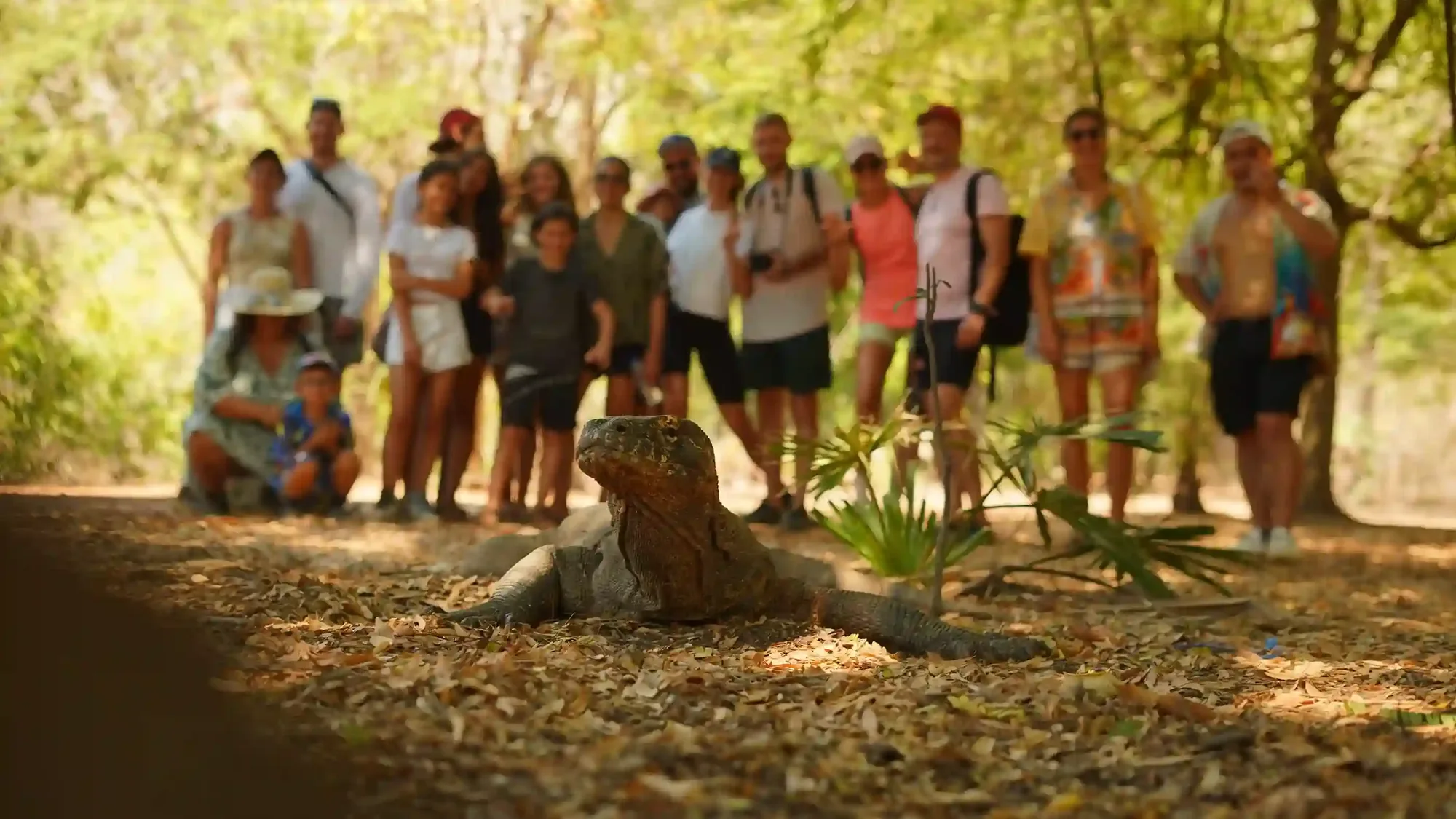
Groups typically walk in a single file behind the ranger along a marked dirt trail, stopping wherever dragons or other notable wildlife (deer, wild boar, various bird species) are spotted near the path. Treks generally run somewhere between 30 minutes and just over an hour depending on which trail length is booked and how much wildlife activity there is to pause for. Rangers keep a respectful, safe distance from any dragon encountered and will direct the group’s positioning — following their instructions immediately, without exception, is the one non-negotiable rule of the walk.
What should you actually do (and not do) during the trek?
- Stay behind the ranger and within the group at all times — don’t wander ahead or fall behind to get a better photo angle.
- Keep a respectful distance from any dragon the ranger points out; don’t approach for a closer shot.
- Wear closed shoes — the trail surface is uneven dirt and rock, not suited to sandals.
- Follow the ranger’s instructions immediately if they ask the group to stop, move, or reposition.
- Don’t bring food onto the trail — the scent can attract wildlife attention unnecessarily.
What training do Komodo National Park rangers actually receive?
Rangers are park authority staff trained specifically in dragon behaviour, trail safety and wildlife management for the specific terrain they patrol, building experience over repeated seasons walking the same trail networks and observing the same resident dragon population. This ongoing, location-specific experience is precisely what an untrained visitor can’t replicate regardless of how much they’ve read in advance — a ranger knows which individual dragons tend to be near the trail at a given time of day and how a specific animal is likely to react, knowledge that only comes from sustained time on that exact ground.
What happens if a dragon approaches the group during a guided trek?
The ranger takes the lead in managing the situation — typically directing the group to stop, move back, or reposition, using their trained judgment of the specific animal’s behaviour rather than a fixed, one-size-fits-all script. This is exactly why immediate compliance with ranger instructions matters more than any other single rule of the trek: a calm, controlled response guided by someone with direct experience reading dragon behaviour is far safer than an untrained group’s instinctive reaction to a genuinely large wild predator at close range.
Do ranger guides carry any equipment for managing dragon encounters?
Rangers typically carry a long forked stick, used defensively to redirect a dragon that approaches too closely rather than as a weapon — a longstanding, practical tool suited to managing an animal that relies on close-range ambush rather than sustained pursuit. This equipment is one more reason the guide requirement isn’t a bureaucratic formality; it reflects genuine, practiced technique for managing an encounter with an animal capable of real harm at close range.
Is there ever an exception to the mandatory guide rule, for researchers or photographers?
Visitors doing formal scientific research, professional filming, or extended specialist work may require additional permits (SIMAKSI-type authorisation) beyond the standard SiOra entry ticket, and even then are still accompanied by trained park staff given the same underlying safety rationale — the mandatory-guide principle doesn’t disappear for specialist visits, it simply sits alongside additional paperwork specific to that kind of extended or specialised access. For a standard tourist visit, there’s no path to walking the trails unguided regardless of experience level or photography ambitions.
Can you request a specific trail length or difficulty level from your ranger?
Trails at each entry point typically come in a couple of standard length options rather than being fully custom per group, and your ranger will generally match the walk to what’s reasonable for your group’s pace and the day’s conditions. If mobility or fitness is a genuine concern for someone in your group, mentioning it to the ranger or your boat crew beforehand helps them plan accordingly rather than assuming everyone in a mixed group can manage the same pace.
Ranger guidance beyond dragon trails: Pink Beach and Wae Rebo
Pink Beach in Komodo really does have a visible pink hue, especially in bright midday light. The colour comes from tiny fragments of red coral mixed with white sand, so you see a soft rose tint rather than neon fuchsia. Photos online are often saturated, but you will still notice the colour with your own eyes.
On Pink Beach itself you do not walk with a ranger. Standard practice is that the boat crew drops you in the designated swimming area and you are free to snorkel or relax on the sand within the marked zone. A ranger accompanies you only on official dragon treks or on clearly signposted protected trails where guides are required.
You must still follow your boat crew’s briefing. Currents can be strong, and there are no lifeguards on Pink Beach. Stay close to your group, keep an eye on surface traffic, and avoid standing on or touching coral. Your guide on the boat, not a park ranger, will usually act as your safety reference here.
How ranger-guided experience compares to Wae Rebo village
Wae Rebo village is outside Komodo National Park and needs a different sort of guide. The trek is a sustained uphill walk on a clear path that most reasonably active people can manage, but you should expect several hours on your feet with some steeper sections and hot, humid air.
Local village or community-based guides lead the Wae Rebo hike rather than Komodo rangers. They manage the pace, explain village etiquette and help coordinate your overnight stay. Good trail shoes, light rain protection and basic hill-walking fitness are enough for most visitors, but if you rarely exercise you will feel the climb.
Frequently asked questions
Is the ranger guide fee included in most Komodo tour packages?
Yes, on almost every properly organised Komodo Boat Tour from Labuan Bajo, since the operator books your SiOra session and guide fee together as part of arranging the permit — confirm this explicitly with your operator regardless, as with any inclusion.
Can children go on the ranger-guided dragon trek?
Generally yes, with the same rules applying to all ages — staying close to the group and following ranger instructions matters more than age itself, though very young children may find the walking distance and heat more tiring than adults.
How many rangers accompany one group?
Typically one ranger per group, sometimes with a second ranger for larger combined groups — group sizes and ranger allocation are set by the park authority at the entry point on the day.
Can you ask the ranger questions during the walk, or is it a silent trek?
Rangers generally welcome questions throughout the walk and often share context about the wildlife, terrain and park history unprompted — engaging with the ranger typically adds meaningfully to the experience rather than detracting from it.
Ask Komodo Luxury about the dragon trek on WhatsApp →
Related reading: SiOra Booking, Permits & Visitor Quota for Komodo National Park · Fees & Permits Quick Answer · Komodo Dragon Facts · Komodo Boat Tour on Komodo Luxury
Is Pink Beach in Komodo actually pink when you see it in person?
Yes, Pink Beach has a real, natural pink tint, but it is softer than many photos suggest. The sand is a mix of white grains and red coral fragments, so it looks pale rose rather than bright magenta. Strong sunlight makes the colour stand out more, while clouds or late afternoon light make it subtler.
How hard is the Wae Rebo village trek and what fitness do I need?
The Wae Rebo trek is a steady uphill hike on a clear path that most moderately fit travellers can complete. Expect several hours of walking with some steeper stretches, warm temperatures and humidity. If you can manage a few hours of hill walking at home, you will usually cope, though you will likely find it tiring.
Do I need a Komodo ranger for the Wae Rebo trek as well?
No. Wae Rebo lies outside Komodo National Park, so you walk with local or community guides instead of park rangers. These guides know the route, manage rest stops and introduce you to village customs. The mandatory ranger rule only applies inside Komodo National Park on designated dragon trails and certain protected routes.
Do I need a guide or ranger on Komodo Island?
Yes, a park ranger guide is mandatory for all treks on Komodo Island, as well as Rinca Island, where Komodo dragons are present. This requirement ensures visitor safety and adherence to park regulations, particularly when encountering these wild animals. The ranger guide fee is approximately IDR 150,000 per group.
How close can you get to a Komodo dragon on a tour?
Park rangers ensure a safe and respectful distance is maintained from Komodo dragons during guided tours. While there isn’t a fixed measurement, rangers will position the group to allow for good observation without disturbing the animals or compromising visitor safety. It is crucial to always follow your ranger’s instructions.
Do I need to worry about Komodo dragons on a guided tour?
While Komodo dragons are wild and potentially dangerous animals, you should not worry excessively on a guided tour. The mandatory park ranger guides are highly trained to manage encounters and prioritize visitor safety. By following their instructions closely, you can enjoy the experience with peace of mind.
Is the Pink Beach in Komodo really pink or is it just Instagram editing?
Yes, the Pink Beach (Pantai Merah) in Komodo National Park is genuinely pink. Its unique hue comes from microscopic red foraminifera organisms that live in the coral reefs, whose fragments then mix with white sand. The intensity of the pink can vary depending on sunlight and water conditions, but it is a natural phenomenon, not just editing.
What is Padar Island famous for?
Padar Island is famous for its panoramic viewpoints, looking over three distinct crescent-shaped beaches, each with different colored sand. The hike to the summit provides unparalleled photographic opportunities, making it one of the most sought-after destinations within Komodo National Park for its unique natural beauty.