
In short
Most Komodo travel content either ignores health risk entirely or repeats a vague “consult your doctor” line without saying what the actual official guidance is. Neither helps you decide what to pack, whether to start malaria tablets, or how seriously to take a mosquito bite on Rinca Island. This page lays out exactly what CDC, WHO, and the Indonesian Ministry of Health have published for this specific region, what they have not published, and what that means practically for a Labuan Bajo and Komodo National Park trip.

Most Komodo travel content either ignores health risk entirely or repeats a vague "consult your doctor" line without saying what the actual official guidance is. Neither helps you decide what to pack, whether to start malaria tablets, or how seriously to take a mosquito bite on Rinca Island. This page lays out exactly what CDC, WHO, and the Indonesian Ministry of Health have published for this specific region, what they have not published, and what that means practically for a Labuan Bajo and Komodo National Park trip.
Is malaria really a risk in Labuan Bajo and Komodo?
Yes, according to the clearest available source. The CDC’s “Malaria Information and Prophylaxis, by Country” table for Indonesia lists all areas of eastern Indonesia — including the provinces of Maluku, North Maluku, East Nusa Tenggara, Papua, and West Papua — as malaria transmission areas, and explicitly names “the town of Labuan Bajo and Komodo Islands in the Nusa Tenggara region” within that list (CDC, 2025). This is a direct, named reference to the exact destinations covered on this site, not a generalisation about Indonesia as a whole. By contrast, the CDC lists Jakarta, Ubud, Bali and Java resort areas, the Gili Islands, and the Thousand Islands as having no malaria transmission — so the risk profile genuinely differs between a Bali holiday and a Labuan Bajo/Komodo trip.
CDC’s guidance for this risk category recommends chemoprophylaxis: atovaquone-proguanil, doxycycline, mefloquine, or tafenoquine, depending on individual health factors (CDC, 2025). Chloroquine is explicitly not recommended, because chloroquine-resistant malaria strains are present in Indonesia. Nationally, CDC’s species breakdown for Indonesia shows Plasmodium falciparum accounting for roughly 60% of cases and Plasmodium vivax roughly 40%, with P. knowlesi present and P. malariae and P. ovale rare (CDC, 2025) — this is a national figure, not specific to Manggarai Barat, and CDC does not publish a finer “low/moderate/high” risk grading for Labuan Bajo itself, only the binary of “area with malaria” versus “area without.”
WHO’s 2024 malaria country profile, drawing on the World Malaria Report 2024, notes that Indonesian malaria cases are now concentrated in the eastern provinces, particularly East Nusa Tenggara and Papua. A 2025 WHO-Indonesia release states that Indonesia reported 418,546 malaria cases in 2023, with 93% of national incidence occurring in East Nusa Tenggara and other eastern provinces including Papua (WHO Indonesia, 2025). No publicly available WHO or Ministry of Health document gives a district-level 2025-2026 malaria case count specifically for Manggarai Barat (the district containing Labuan Bajo) — that is a genuine gap in published data, not something this page can responsibly estimate.
What about dengue fever?
Dengue is separately documented and endemic across Indonesia, including East Nusa Tenggara. The most specific figure available is from the Indonesian Ministry of Health: in January 2023, West Manggarai (the district containing Labuan Bajo) recorded 55 dengue cases, contributing to a combined East Nusa Tenggara and Jakarta total of 710 cases and 6 deaths in that single month, with a case fatality rate of 0.26% (Indonesian Ministry of Health, 2023, via Antara). Nationally, WHO’s 2024 monthly surveillance reported 373,528 suspected dengue cases by week 22 of that year (WHO Indonesia, 2024), and WHO has been developing a National Dengue Action Plan 2026-2029 in consultations held through mid-to-late 2025, reflecting sustained high dengue burden (WHO Indonesia, 2026).
Neither WHO nor the Ministry of Health publishes a formal traveller-facing risk classification (low/moderate/high) for dengue in this district. What can be stated with confidence is that dengue transmission is documented in West Manggarai specifically, and that the disease is endemic and recurrently epidemic nationwide — meaning mosquito-bite prevention matters for dengue just as much as for malaria, since there is no vaccine broadly recommended for short-term travellers to this region.
| Disease | Documented in this region? | Specific data point | Source |
|---|---|---|---|
| Malaria | Yes — named area | Labuan Bajo and Komodo Islands explicitly listed as malaria transmission areas | CDC, 2025 |
| Malaria (national) | Yes | 418,546 cases in 2023; 93% in East Nusa Tenggara and other eastern provinces | WHO Indonesia, 2025 |
| Dengue | Yes — district-level case data | 55 cases in West Manggarai, January 2023 | Indonesian Ministry of Health, 2023 |
| Dengue (national) | Yes | 373,528 suspected cases by week 22, 2024 | WHO Indonesia, 2024 |
| Rabies | Regional emergency flagged | East Nusa Tenggara rabies situation flagged in 2025 reporting | WHO Indonesia, 2025 |
What vaccinations should I get before a Flores or Komodo trip?
The CDC’s Travelers’ Health guidance for Indonesia recommends, for most travellers: being current on routine vaccines (MMR, diphtheria-tetanus-pertussis, varicella, polio, annual influenza), plus Hepatitis A (food and water transmission) and Typhoid, especially for travellers eating outside major hotels or visiting smaller towns (CDC Travelers’ Health, 2025). Hepatitis B is recommended for travellers with potential exposure through medical care, sexual contact, or tattoos/piercings, or for longer stays. Rabies pre-exposure vaccination is worth considering given WHO’s 2025 rabies emergency flag for East Nusa Tenggara, particularly if you expect close contact with animals. Japanese encephalitis is considered for travellers spending a month or more in rural areas with heavy outdoor exposure. CDC does not recommend any vaccine specifically for malaria or dengue — prevention for both instead relies on chemoprophylaxis (malaria only) and mosquito-bite avoidance for both.
WHO’s general international travel health guidance broadly mirrors this: Hepatitis A and Typhoid for most travellers to areas with intermediate-to-high enteric disease burden, Hepatitis B based on exposure, and full routine immunisation, including measles, given ongoing global outbreaks.
Is drinking water safe in Labuan Bajo?
No official source certifies municipal tap water in Labuan Bajo as safe for direct drinking, and the near-universal practice among hotels, boat operators, and travellers is bottled or filtered water. This is a standard, low-cost precaution rather than a sign of any unusual local risk — it is the same practice recommended across most of Indonesia outside major hotel chains with their own filtration systems.
What happens if I get sick or injured on a boat trip?
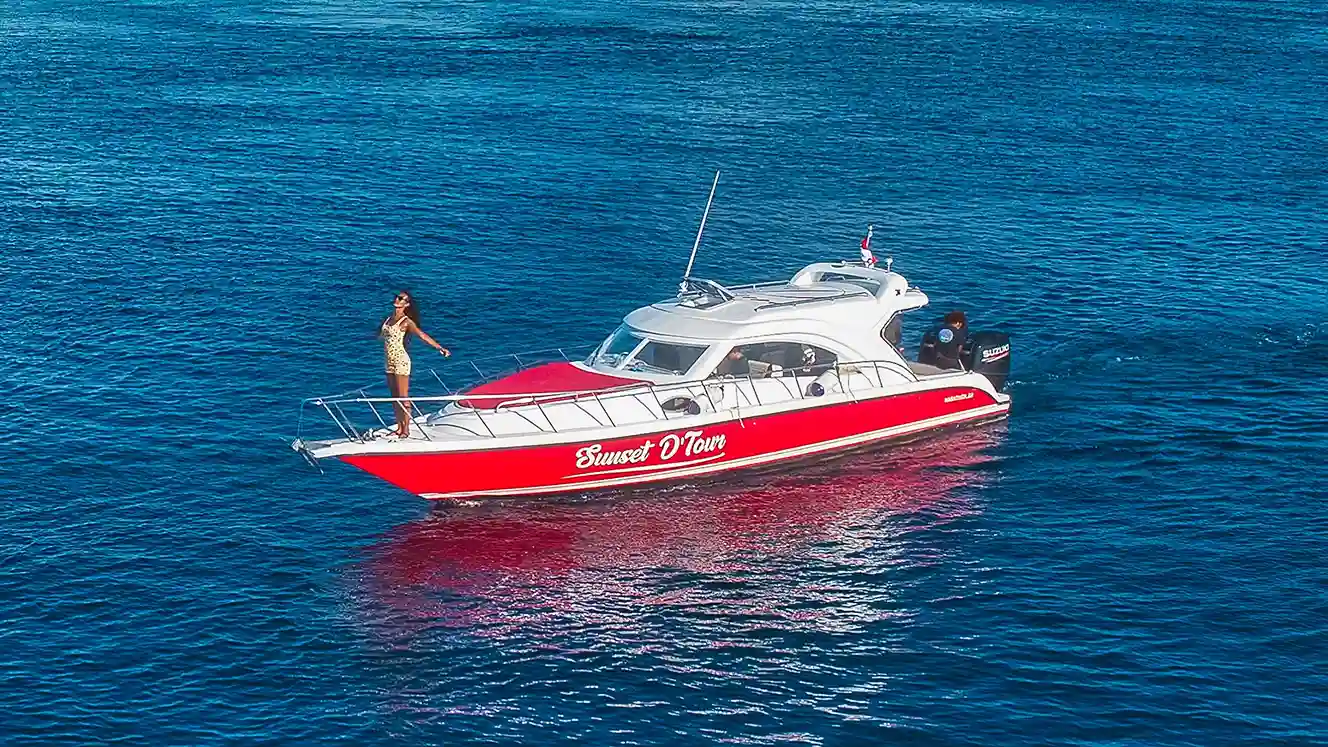
Labuan Bajo town has hospital and clinic facilities; the islands inside Komodo National Park generally do not, which means any medical issue that occurs mid-trip needs to be managed until the boat can return to town or reach the nearest accessible point. Reputable liveaboard and charter operators, including those listed on Komodo Luxury’s boat tour page, carry a basic first-aid kit and brief guests on the plan for a medical issue before departure. If you have a pre-existing condition, are travelling with young children, or are pregnant, it is worth asking your operator directly what their medical evacuation or nearest-clinic plan looks like before booking a multi-day itinerary far from Labuan Bajo.
Practical mosquito-bite prevention for a boat trip
Because both malaria and dengue are mosquito-borne and neither has a broadly recommended travel vaccine for short-term visitors, bite prevention does double duty here. DEET or picaridin-based repellent, long sleeves and trousers particularly at dawn and dusk (when Anopheles malaria mosquitoes are most active) and during the day (when Aedes dengue mosquitoes tend to bite), and sleeping under air conditioning or a mosquito net where available all reduce exposure. Boats anchored overnight near mangrove islands such as Kalong can have higher mosquito activity around dusk; this is a reasonable moment to apply or reapply repellent even if you have not needed it elsewhere that day.
Where the data runs out
In the interest of not fabricating precision that does not exist: there is no official, publicly published 2025-2026 malaria or dengue incidence figure specifically for Manggarai Barat district (which contains Labuan Bajo) from WHO or Indonesia’s Ministry of Health in the documents available at the time of writing. The most specific figures available are the CDC’s explicit naming of Labuan Bajo and Komodo Islands as a malaria area (2025) and the Ministry of Health’s January 2023 dengue count for West Manggarai. Any claim more precise than that — a stated percentage chance of infection on a given trip, for instance — is not supported by a citable official source and this page does not make one up.

Safety, culture and smart budgeting for a Komodo trip
Earthquake and tsunami risk
Flores lies in an active seismic zone, so mild earthquakes are common. In Labuan Bajo, choose accommodation that is not right on the waterline if quakes worry you. If you feel strong shaking, move away from walls and glass, then go to higher ground once it is safe to exit. Steep hills behind town provide natural refuge during a tsunami warning.
Cultural customs on Flores and Labuan Bajo
Flores is largely Catholic with strong local traditions and some Muslim communities. Dress modestly in town and villages: shoulders covered, shorts or skirts near knee-length. Always ask before photographing people or ceremonies. Use your right hand to give or receive items. A simple greeting and smile go a long way when entering a small shop or warung.
Meeting Komodo dragons safely
On Komodo and Rinca you must stay with the ranger at all times, keep several metres from dragons and never run. Do not bring plastic bags with food, and avoid visiting while intoxicated. Parents should keep children beside them, not in front of the group. Follow instructions immediately if the ranger changes the route.
Budget tips, repellents and family or student trips
You can keep costs lower by travelling outside July and August, joining a shared boat, and eating in local warung instead of resort restaurants. Students often choose one long day trip instead of overnight boats. Buy mosquito repellent, sunscreen and basic medicines in Labuan Bajo before sailing; it is easier than relying on the boat’s supplies.
Most mid-range hotels provide mosquito nets or have well-sealed rooms and air conditioning. Budget options may use stand-alone nets, so check at booking if this matters to you. For family trips, pick boats with cabins that close properly and ask operators about life jackets in children’s sizes.
Sources
- CDC Yellow Book — Malaria (current edition; the older cdc.gov malaria country-table URL was retired by CDC and this citation was moved to the live page on 27 August 2026)
- CDC Travelers’ Health — Indonesia (2025)
- WHO Indonesia — malaria and dengue country reporting (2024-2026)
- Antara News, citing Indonesian Ministry of Health dengue surveillance (2024)
Updated: August 26, 2026 · Originally published: August 20, 2026